Calais - Dover
Ferries to England
Calais - Dover
Ferries to England



Last Updated: 2026-10-23
On the Calais Dover route, fares generally fall between $40* and $500*. On average, a Calais Dover ferry ticket costs around $271*, with the lowest Calais Dover fares starting at $40*. Foot passengers pay an average of $102*. Traveling with a car adds up to an average fare of $255*.
Actual fares depend on passenger numbers, vehicle type, chosen route and sailing time. Figures are based on fares searched over the past 30 days, exclude service fees, and were last refreshed October 26.
Compare fares, operators and sailing times from across the globe in one place, then book with confidence. Booking ahead is the easiest way to lock in a better price and a wider choice of departures.
Yes. Direct Ferries runs a number of discounts throughout the year. If a senior discount applies to your route, it's applied automatically once you select the right age range in the passenger options during your search.
Students and recent graduates can save 5% on their booking. Simply register with our partner Student Beans to verify your status, and you'll be issued a discount code to apply at checkout.
On several Spanish and Italian routes, residents can also access a discounted fare — look out for the "Residents" option during your search, which applies the reduced price automatically. Keep in mind you'll be asked to show proof of residency, such as a registration certificate or an ID card showing your address, at check-in.
Calais Dover sailings usually begin with a departure from Calais at approximately 00:10, with the final sailing of the day leaving around 23:00.
Absolutely, the short crossing time and frequent daily sailings make Calais to Dover a popular choice for a day trip. If you can, bringing a vehicle lets you venture further afield once you arrive, on your own schedule.
Yes, Irish Ferries & P&O Ferries operates car-friendly sailings between Calais and Dover. Use our Deal Finder to check live pricing for taking a vehicle on this route.
Whether a campervan or caravan is permitted on the Calais to Dover crossing depends on the ship and operator running your preferred sailing. Enter your travel details into our Deal Finder, and we'll compare the operators on this route to confirm your options.
Yes, Irish Ferries & P&O Ferries welcomes bicycles on the Calais to Dover crossing. Bikes are accepted by most ferry operators, though it's worth confirming the specific policy in advance so there are no surprises at the terminal.
Yes, P&O Ferries accepts foot passengers on sailings between Calais and Dover.
Good news for pet owners — Irish Ferries & P&O Ferries allows pets on board sailings between Calais and Dover. Traveling with a pet on this route costs an average of $413.
Figures reflect fares searched over the last 30 days, exclude service fees, and were last updated October 26.
When you bring a pet on board, you'll typically need to have the following ready:
This varies by operator — on some ferries, pets must stay in your vehicle for the whole crossing, while others provide dedicated pet zones, pet-friendly cabins, or lounge areas. Check our Deal Finder to compare the pet arrangements on offer and choose the crossing that suits you and your pet best.
A few things are worth knowing before you travel with a guide or assistance dog. We'd suggest letting our customer service team know, or flagging it with the ferry operator when you book, that you'll be travelling with an assistance animal.
Bring along any relevant certification and paperwork too, since you may need to show it at boarding or at some point during the crossing.
Even on sailings where pets generally aren't permitted, different rules often apply to guide dogs and assistance dogs. Get in touch with our customer service team to confirm the specific policy for your sailing, or visit our Special Assistance Help page for general guidance.
Overnight sailings on the Calais to Dover route aren't guaranteed and depend on a range of factors. Run a search with your travel details and our results will show whether an overnight option is available, along with current timetables, crossing times, and day-sailing alternatives.
Bear in mind that overnight crossings can run a little longer than their daytime equivalents.
Document requirements aren't the same on every route, so it's worth confirming what you'll need before you travel. A valid passport is generally required for the Calais to Dover crossing, alongside any visas or national ID your nationality calls for. Exact requirements depend on your citizenship and the rules of your destination country, so for the latest guidance and to avoid delays at check-in, take a look at our Check-in, Travel Documents & Tickets guide.
Booking is straightforward: enter your departure and arrival ports along with your travel date to pull up every available sailing and fare. You can also browse alternative routes and departure times to find the option that works best for you.
Keep an eye out for early-booking savings and flexible ticket types, including upgrades or flexi-fares that let you amend or cancel later on. For a hassle-free booking, double-check the details you enter, such as passenger numbers and any vehicle specifications.
As soon as your booking is confirmed, you'll get a confirmation email. Exactly how your boarding pass is issued after that depends on which operator you've booked with.
Some operators send your boarding pass out the moment you book, while others require check-in at the port itself. Where it's offered, online check-in is also available through the Direct Ferries app, saving you a step at the terminal.
You'll typically find the ticket desk close to the ferry terminal itself. It's a good idea to arrive a little early so you have plenty of time to collect your tickets and get checked in without rushing.
At check-in, have your confirmation email ready along with valid photo ID, such as a passport or identity card. If you're travelling with a pet, bring along their vaccination and insurance paperwork, and if you booked using a resident discount, be prepared to show proof of address too.
A few things can explain a lack of sailings on your chosen date: a temporary schedule change, limited space, or a seasonal shift in the timetable are the most common. It's worth trying a nearby date or exploring alternative routes using our Route & Port finder.
As a rule, the earlier you book your Calais to Dover ferry, the better. Booking ahead tends to secure lower fares along with a wider pick of departure times and cabin or seating options.
Aim to book at least a few weeks ahead to make the most of the best available offers, keeping in mind that fares can shift depending on the season and how much space is left.
More routes than anyone else.

Compare fares, times & routes in one place.
Change plans easily with flexi tickets.

Book e-tickets & manage trips in-app.
Live ship tracking & real-time updates.

Top-rated customer support when you need it.
| Calais - Dover Ferry Route Prices | ||
|---|---|---|
| Foot Passenger | $102 | |
| Average Price with Car | $255 | |
| Average Price with Motorcycle | $143 | |
| Average Campervan Price | $407 | |
| Average Cabin Price | $422 | |
| Calais - Dover Ferry Route Summary | |
|---|---|
| Origin | France |
| Destination | England |
| No. of Operators | 3 |
| Operators | Irish Ferries, P&O Ferries & DFDS Seaways |
| Average Price | $271 |
| Average Pet Price | $413 |
| Average Daily Sailings | 31 |
| Average Weekly Sailings | 211 |
| Average Sailing Duration | 1 h 35 m |
| Fastest Sailing Duration | 1 h 30 m |
| First Ferry | 00:10 |
| Last Ferry | 23:00 |
| Distance | 33 Nautical Miles |
* Prices subject to change, pricing is taken from last 30 days, last updated 23 October 2026.
The French town and major sea port of Calais is located in northern France and lies on the English Channel coast, around 21 miles across the English Channel from the English Port of Dover. On a clear day it is possible to see the White Cliffs of Dover, across the Strait of Dover. Calais' old town, known as Calais-Nord, is surrounded by canals and harbours and lies on an artificial island. The more modern part of Calais, known as St-Pierre, is located to the south of the old town.
Visitors to the town can take in the Tour du Guet which is situated in the Place d'Armes in the old town. Built in the 13th century, the structure was originally a water tower which was subsequently used as a lighthouse until 1848.
The port of Calais is well known to many visitors from the UK and is the 4th largest port in France, by passenger numbers. It is the main gateway into France for many UK visitors and is less than 3 hours by car from Paris, Brussels and London and is connected to several motorways. On average a ship departs from Calais every 30 minutes, with around 50 departures to Dover each day, with a crossing time of about 75 minutes.
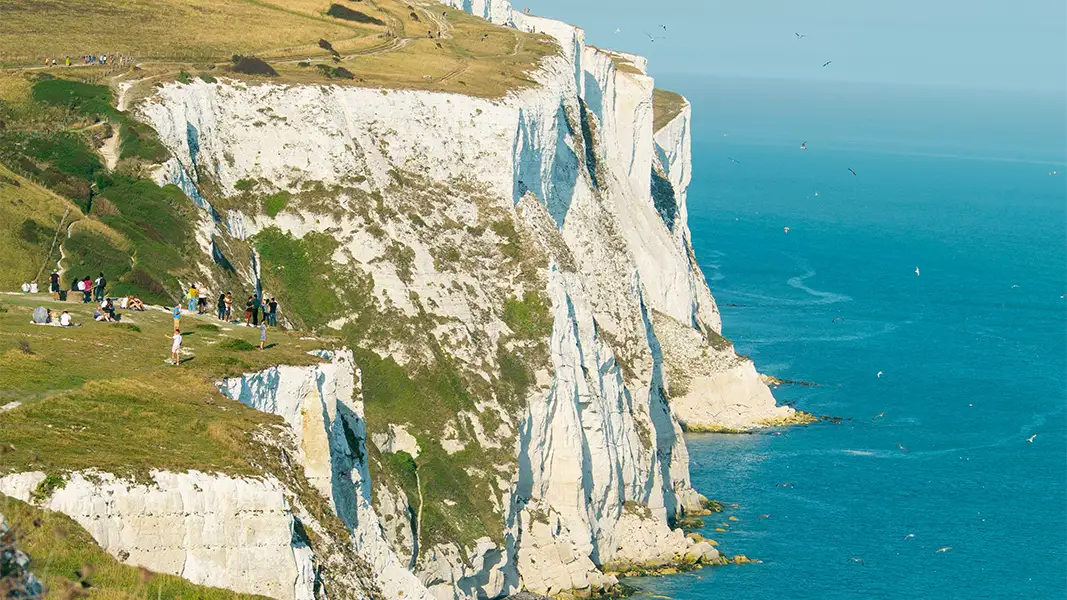
The town and port of Dover is located on the south east coast of England, in the county of Kent. The major ferry port lies on the English Channel coast, at its narrowest point between England and France. Dover is the world's busiest passenger port with roughly 16 million travellers, 2 million lorries, nearly 3 million cars and motorcycles and 86,000 coaches passing through it each year. Providing an iconic backdrop to the town are its white chalk cliffs and are an impressive sight when entering the port by ferry.
A popular tourist attraction in the town is the 12th century Dover Castle which stands guard over the town. The medieval castle has been described as the "Key to England" because of its defensive importance over the centuries, and is also England's largest castle. Today, the castle is a designated Scheduled Monument which means that it is a nationally important historic building and archaeological site that is protected against unauthorised change. It is also a Grade I listed building and an internationally recognised important structure. The castle, its secret tunnels and surrounding land are all now owned by English Heritage.